

When I first realized my campaigns were failing, it wasn’t because of budget.
It was because of mistakes I didn’t even know I was making. Clicks were coming in. Spend was increasing. But conversions? Almost none.
That’s when I started analyzing ppc mistakes killing conversions, and fixing them completely changed my results. Once I eliminated the hidden issues, my campaigns became more efficient, predictable, and profitable.
If your PPC campaigns are underperforming, chances are you’re making one (or more) of these mistakes.
Key Takeaways
- Most PPC failures come from avoidable mistakes
- Conversions drop when intent and targeting don’t match
- Poor landing pages destroy even the best campaigns
- Tracking mistakes lead to wrong decisions
- Fixing small issues can dramatically improve performance
What Are PPC Mistakes That Kill Conversions?
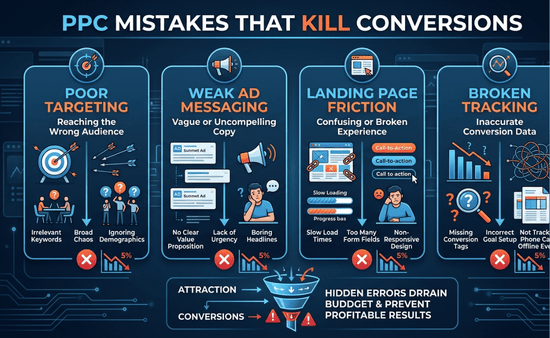
These are errors in your campaign setup, targeting, messaging, or tracking that prevent users from converting.
The worst part?
Many of these mistakes are not obvious. You can be getting traffic and still lose money. That’s why identifying and fixing them is critical.
Mistake 1: Targeting the Wrong Keywords
This is the most common and expensive mistake. When I started, I targeted high-volume keywords. They brought traffic—but not conversions. The problem was intent. I was targeting users who were browsing, not buying.
To fix this, I focused on intent-driven keywords.
If you want to improve this, start with: how to find ppc keywords
Better targeting brings better results.
Mistake 2: Sending Traffic to the Wrong Landing Page
This mistake alone can kill conversions. Even if your ad is perfect, a poor landing page ruins everything. I made this mistake by sending users to my homepage.
It confused them. Now I always:
- Match the landing page with the ad
- Keep messaging consistent
- Use clear calls to action
A focused landing page converts better than a general one.
Mistake 3: Ignoring Conversion Tracking
For a long time, I ran campaigns without proper tracking.
I had no idea what was working. That led to poor decisions. Now I always ensure tracking is set up before launching campaigns.
If you haven’t done this yet, start here: ppc conversion tracking setup guide
Tracking gives you clarity. Without it, you are guessing.
Mistake 4: Focusing on Clicks Instead of Conversions
Clicks feel good. But they don’t guarantee results. I used to optimize campaigns for traffic.
That was a mistake. Now I focus on:
- Conversion rate
- Cost per conversion
- ROI
If you want to understand this better, explore: track roi from ppc campaigns
Profit matters more than activity.
Mistake 5: Poor Ad Copy That Doesn’t Match Intent
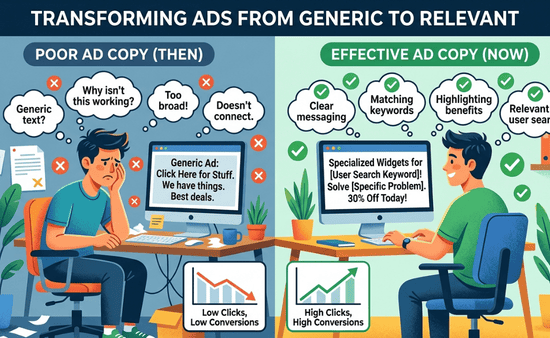
Generic ads don’t convert. I used to write ads that sounded good but didn’t connect with users.
Now I focus on:
- Clear messaging
- Matching keywords
- Highlighting benefits
Your ad should feel relevant to the user’s search. Relevance improves both clicks and conversions.
Mistake 6: Weak Campaign Structure
A messy campaign leads to poor performance. Early on, I mixed too many keywords in one group. This reduced relevance. Now I keep campaigns simple:
- One goal per campaign
- Focused ad groups
- Relevant keywords
This improves both performance and optimization.
Mistake 7: Not Optimizing Campaigns Regularly
This is where many campaigns fail. People set up ads and leave them running. That doesn’t work. I constantly:
- Review data
- Adjust bids
- Test new ads
- Remove underperforming elements
Optimization is what improves results over time.
Mistake 8: High Costs Due to Poor Efficiency
Many campaigns fail because costs are too high. This usually happens due to:
- Low Quality Score
- Poor targeting
- Inefficient bidding
If you’re facing this, refer to: reduce ppc cost without losing traffic
Efficiency matters more than budget.
Mistake 9: Ignoring User Journey and Funnel
This was a major shift for me. I used to treat PPC as a single step. Now I see it as a funnel. Users need:
- Awareness
- Consideration
- Conversion
If you skip steps, conversions drop. To fix this, explore: ppc funnel optimization strategy
A structured funnel improves results significantly.
Mistake 10: Not Using Data to Make Decisions
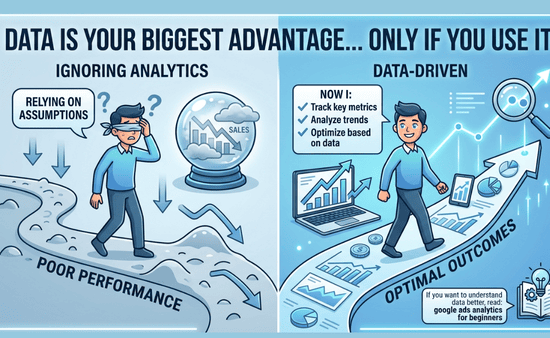
Data is your biggest advantage. But only if you use it. I used to ignore analytics and rely on assumptions. That led to poor performance. Now I:
- Track key metrics
- Analyze trends
- Optimize based on data
If you want to understand data better, read: google ads analytics for beginners
Data-driven decisions lead to better outcomes.
How These Mistakes Impact Your Campaign
When combined, these mistakes lead to:
- High cost per click
- Low conversion rates
- Wasted budget
- Poor ROI
Fixing them improves efficiency across your entire campaign.
How Long Does It Take to Fix PPC Mistakes?
From my experience:
- Quick fixes: 1–2 weeks
- Noticeable improvements: 2–4 weeks
- Strong results: 1–2 months
Consistency is key.
What Actually Improves Conversions in PPC
Here’s what I learned: Conversions improve when everything aligns.
- Keywords match intent
- Ads match keywords
- Landing pages match ads
- Tracking measures performance
When this system works, results follow.
Frequently Asked Questions
1. What is the biggest PPC mistake beginners make?
Targeting the wrong keywords is the most common mistake. It leads to wasted traffic and low conversions.
2. Can fixing mistakes really improve conversions?
Yes, even small fixes like improving ad copy or landing pages can significantly increase conversion rates.
3. How do I know if my PPC campaign has mistakes?
If you have high clicks but low conversions, it usually indicates issues with targeting, messaging, or landing pages.
4. Should I stop campaigns if they are not converting?
Not immediately. First analyze data, fix mistakes, and optimize before deciding to stop.
A Smarter Way to Fix PPC and Drive Conversions
Understanding ppc mistakes killing conversions changed how I manage campaigns.
I stopped blaming the budget and started fixing problems. That shift improved everything. If you identify and fix these mistakes, focus on alignment, and optimize consistently, you won’t just run ads.
You’ll build campaigns that convert consistently.